Engineering intelligent data centers at enterprise scale.
Private AI that reads your BMS, EPMS, DCIM and SCADA, explains every incident and prepares the response, inside your facility.
Select a highlighted asset to see the AI at work
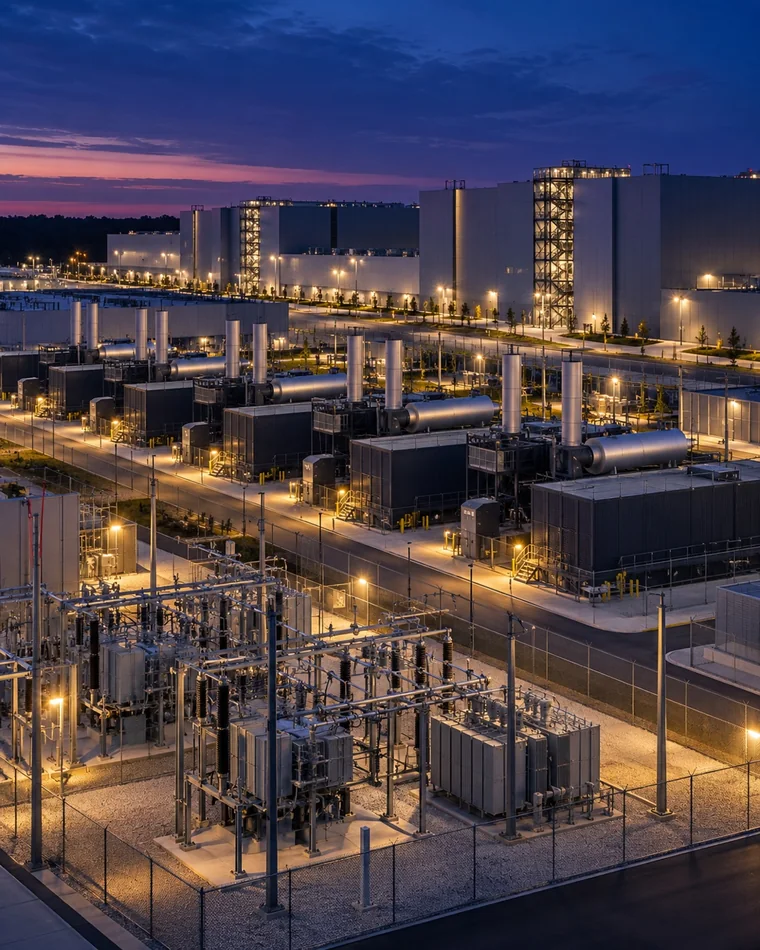
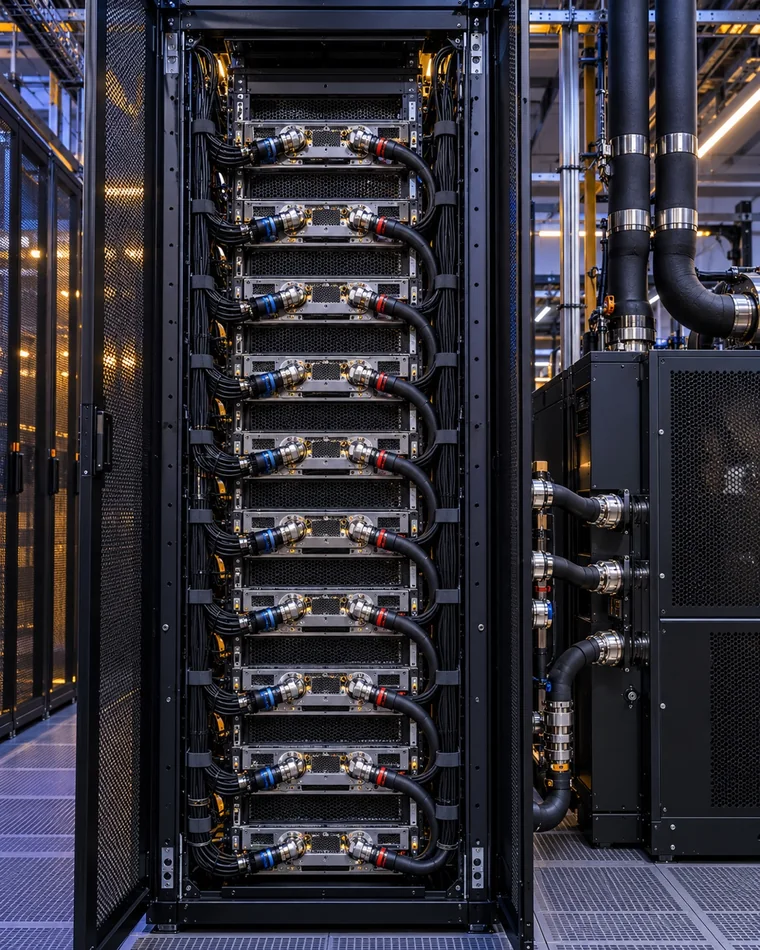
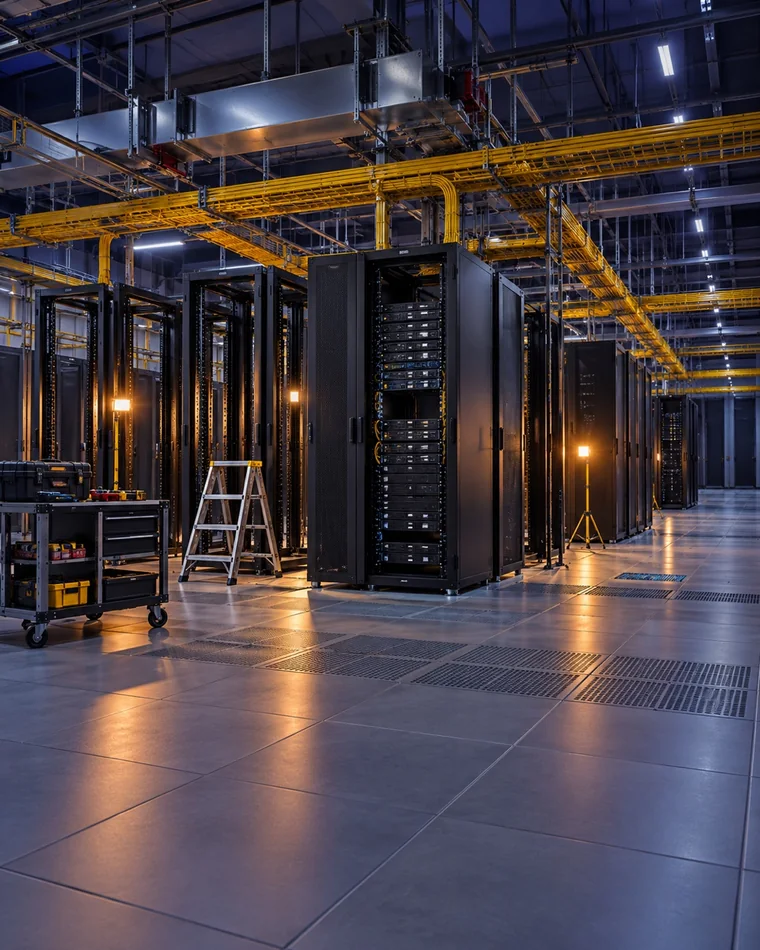
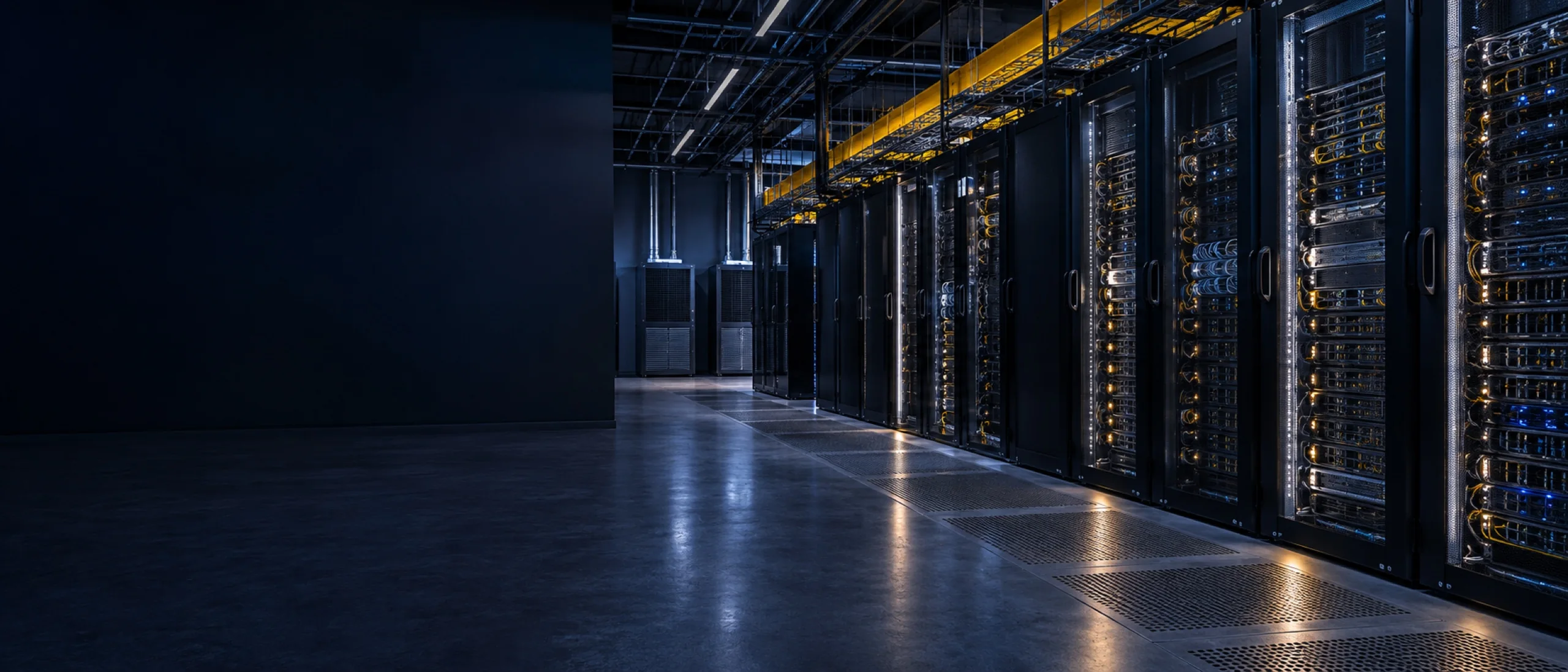
Concept photography · illustrative AI overlay
Built with and alongside
Reads from the systems you already runBMSEPMSDCIMSCADAAVEVA PI SystemOPC UABACnetModbusMQTTServiceNowJiraCMMS
The problem
Sound familiar? Five problems every data center team knows.
The cost of getting them wrong keeps rising, and AI-era density makes all five harder.
1 in 5operators say their latest significant outage cost more than $1 million
85%of human-error outages involve procedures not followed, or procedures that were flawed
66%of operators struggle to hire or keep qualified staff
1.54global average PUE, little changed in six years
Sources: Uptime Institute Annual Outage Analysis and Global Data Center Survey.
Alarm floodsWhich of these 18 alarms actually matters?One chiller trip lights up four consoles. The shift assembles the context by hand.Costs response time
Ageing critical equipmentIt was fine at the last PM.Chillers, CRAH units and UPS strings degrade quietly between inspections.Costs availability
Cooling at AI-era densityWe can’t risk raising the setpoint.Dense racks leave little inlet margin, so plants run colder and costlier than they need to.Costs energy and water
No failure historyIt’s a new hall. Nothing has failed yet.Without past failures there is nothing to train a model on, so prediction waits for years.Costs months of blind spots
Must run air-gappedNothing leaves the site. Full stop.Most AI tools assume the cloud, so security never signs them off.Costs AI that never ships
Solutions
How we unlock value with AI.
Two ways in. Add AI to the consoles your operators already use, or rebuild the incident response around AI agents. Both stand on one foundation, inside your facility.
DCIM · DC1 · Hall 1Floor planPowerCoolingCH-02 trippedChillers 2/3Max inlet 27.8 °C
Rack inlet21242627.5 °Climit 29 °C
IT load12.0 MW
CHW supply11.4 °C ↑
CRAH-12 fan94%
Raw alarms · 15 min18
SOP CW-07 · chiller trip
Confirm the trip on the CH-02 panel
Start standby chiller CH-03
Verify chilled-water supply recovers
Log and notify the shift lead
Handover draft · Shift B
CH-02 compressor trip 02:40 · CH-03 running · Rows G–H on watch · WO-4471 at 06:00
Awaiting shift lead sign-off
NeIO assistantAdded to your DCIM · cites every record
16 racks in Rows G–H run within 2 °C of the 29 °C inlet limit at peak, highlighted on the plan. CRAH-12 is at 94% fan speed with no headroom. The CH-02 work order is open, technician at 06:00.
With CH-03 online the plant keeps N capacity, but no spare.
The assistant works inside the console operators already use, and shows its answer on the floor plan.Illustrative
Peopledecide and approveHeld by policy · routed to ownerApproved
Shift leadApproves the response
Facilities engineerActs on site
NeIO OSPlans the run and routes every exception to the person who owns it.
Your facility · read-only
AI agentsdo the work
Correlation agent18 alarms consolidated into 1 incident
One explained incident instead of four consoles. Engineers own every action.
One foundation under bothEach piece answers a barrier above.
Correlation and root cause
BMS, EPMS, DCIM and SCADA alarms matched on one topology, cause ranked with evidence.
Alarm floods
Physics-first prediction
Degradation caught early, calibrated on your equipment.
Ageing equipment
Cooling under policy
Setpoint advice with margin checks, held during incidents, engineer-approved.
AI-era density
Synthetic training data
Models start trained on synthetic and physics-based failures, then calibrate on site.
No failure history
Your boundary
No external network path. Models run on site.
Must run air-gapped
Ready-made solutions
Start from a solution already running in production.
Built on NeIO and configured to your facility systems, data and boundary.
AI agent
Chillers · CRAH · UPS · Pumps
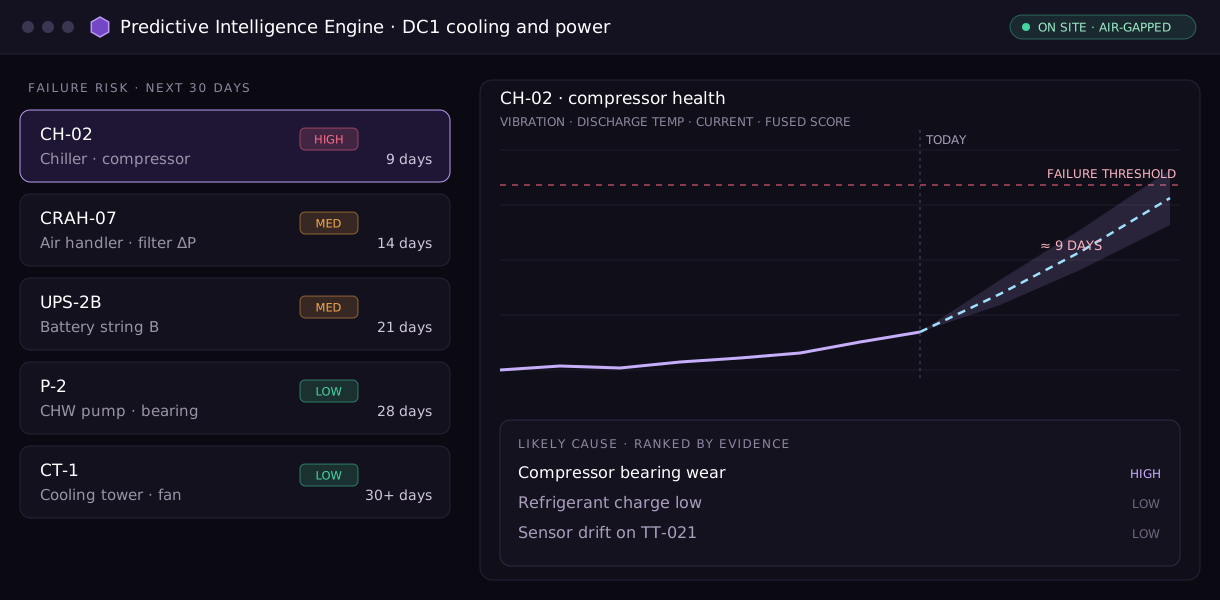
Predictive Intelligence Engine
Predicts chiller, CRAH, UPS and pump failures 7–30 days ahead, with the likely cause ranked by evidence.
AI agent
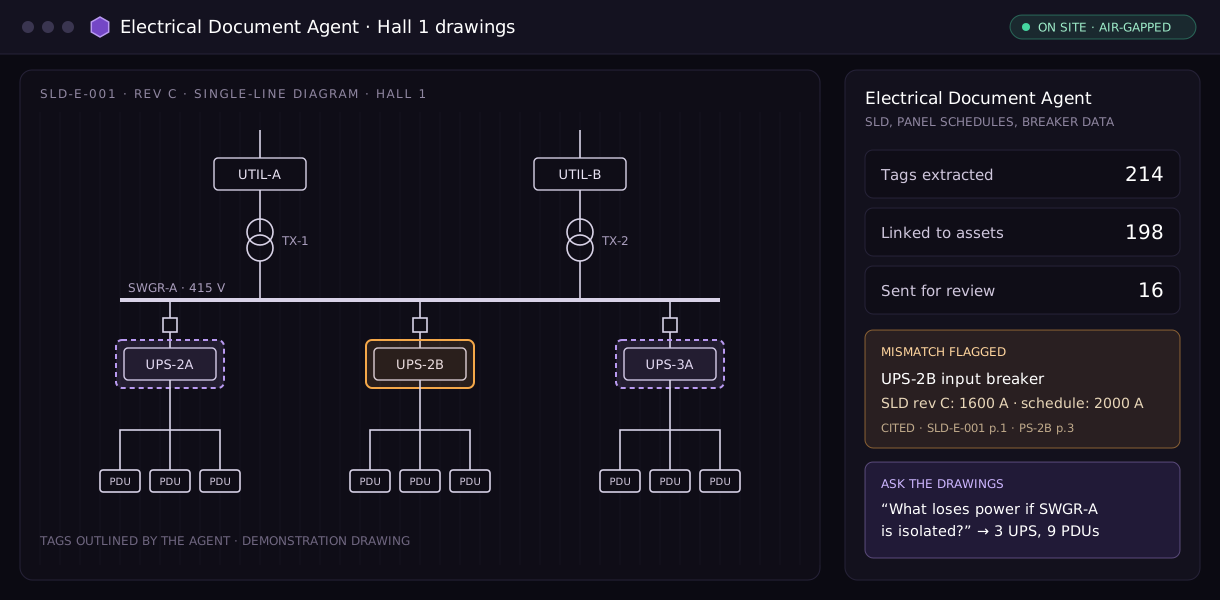
Electrical · Single-line diagrams
Electrical Document Agent
Reads single-line diagrams, panel schedules and breaker data, links every tag and flags what doesn’t match.
Illustrative product screens with demonstration data.
Proof
Explore our deployments
Delivery across hyperscale data centers and industrial platforms. Client identities are confidential; detailed case studies are available on request.
Hyperscale · Predictive maintenanceUSA
Early warning, with the root cause at alert time
Challenge: Critical cooling and power equipment needed earlier warning, in a facility with no external network path.
What we did: Physics-first models calibrated on site, attaching the probable cause the moment an alert is raised. Delivered fully air-gapped.
Air-gappedno external path from the facility
At alertroot cause attached
Incident management · Supervisory AISoutheast Asia
From alert to an approved decision, engineer in control
Challenge: Digital-twin outputs had to become decisions engineers could trust and approve.
What we did: A supervisory layer that turns twin outputs into explained recommendations for approval, now part of the provider’s own platform. Local and air-gapped, with no connection to control or safety systems.
30 salert to explained recommendation (design target)
30 + 15anomaly and degradation contexts (design baseline)
Industrial services · OnboardingGlobal
Sites go live sooner when onboarding is automated
Challenge: New sites waited on manual record mapping and integrations rebuilt from scratch.
What we did: Records and datasheets extracted with every field cited, configuration generated from a blueprint, integrations reused. Mapping needs no OT access, so it starts early.
3–5×faster QA on data and document mapping
Day oneinitial models configured and validated on site
Why Codvo
Why Codvo for data center AI.
We specialise in critical facilities, we already run in them, and we stay after go-live.
01Data-center specialistsReal deployments in hyperscale and critical facilities. We know chillers, UPS strings and BMS points as well as models.02Secure, on-prem, air-gappedModels run inside your facility. Read-only integration, role-based access and a full audit trail.03No cold startSynthetic and physics-based failure data trains models before your equipment has ever failed.04Platform plus acceleratorsPre-built connectors, asset models and governance, so use cases go live in weeks.
Explore your data center AI roadmap
Turn data center intelligence into real-world impact.
Bring one power, cooling, capacity or response challenge. In a 45-minute working session we’ll review your environment, show a comparable scenario and agree what a pilot should prove.


 AI agent
 Shift leadApproves the response
 Facilities engineerActs on site
 AI agent