

Define it.Measure it.Defend it.
Pre-labels your surgical video, checks every label against a certified annotator, routes what it is unsure of to people, and releases only approved labels, each with its evidence.
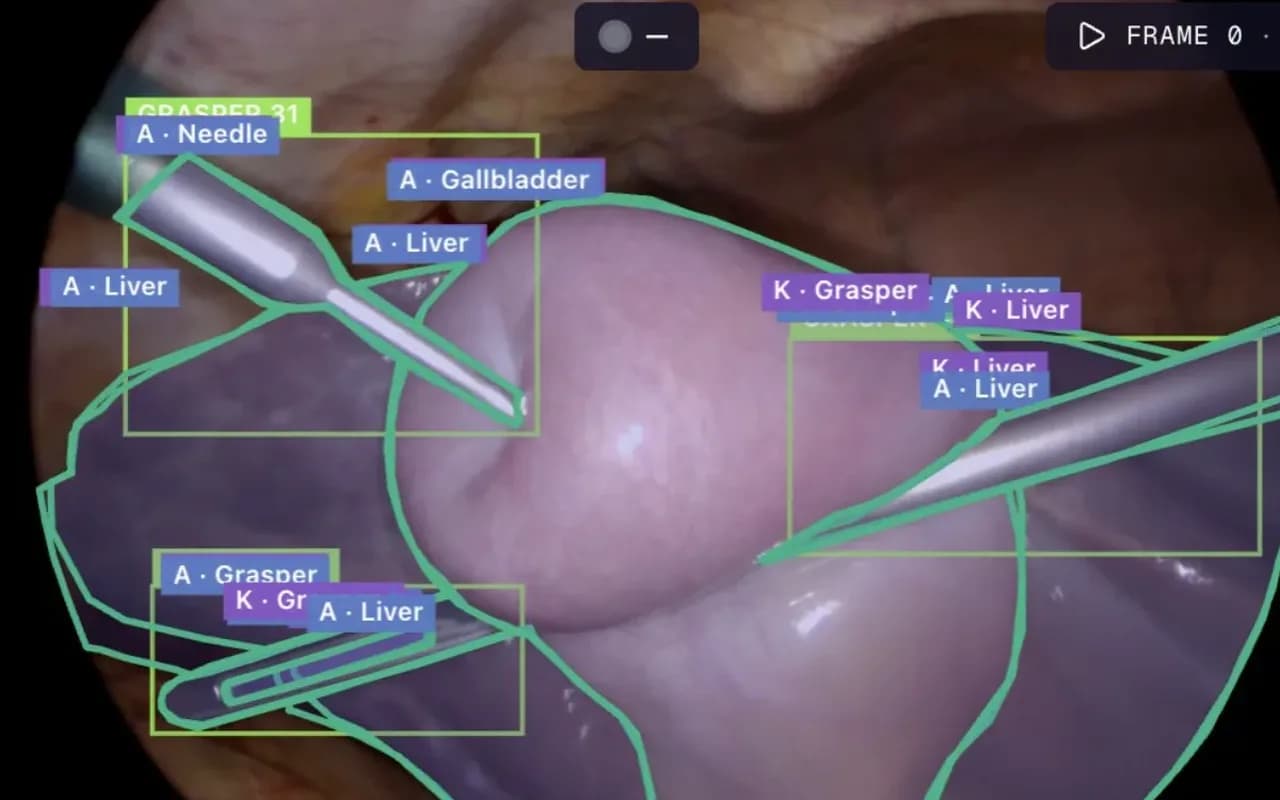
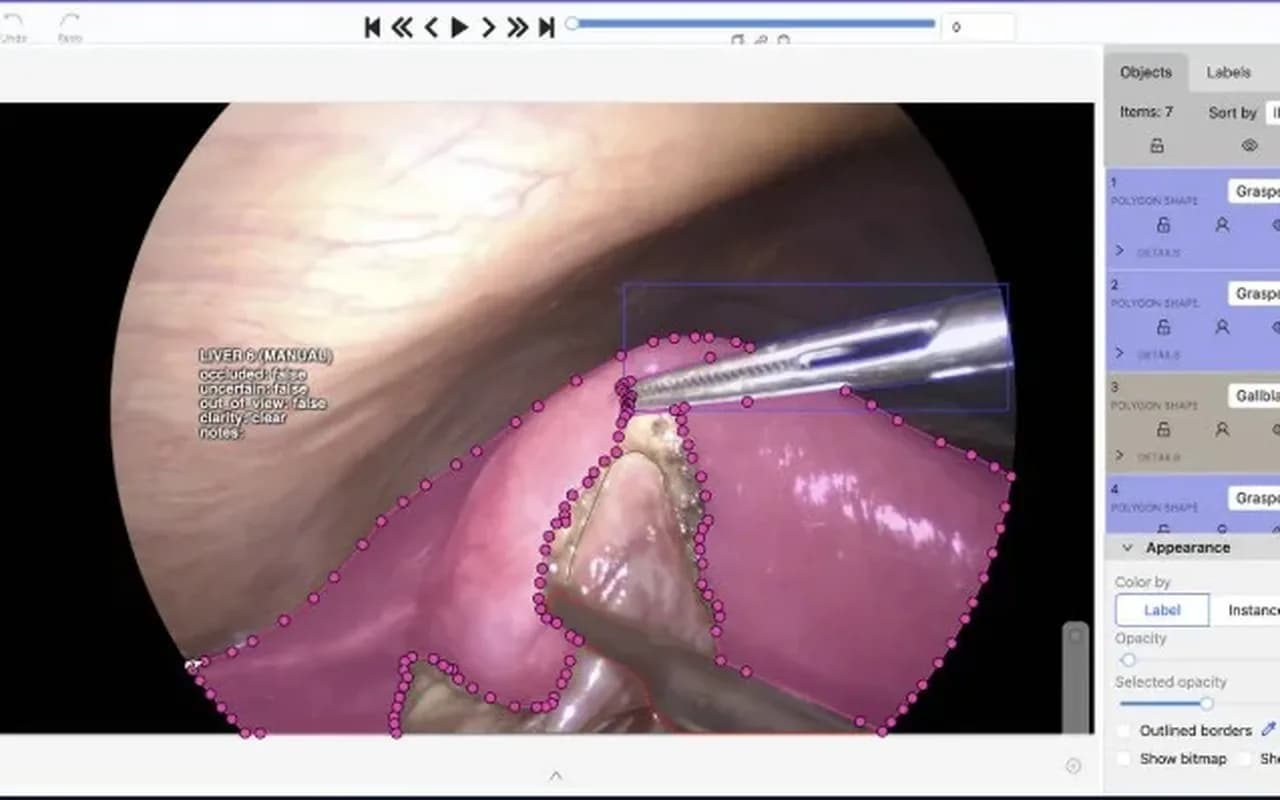
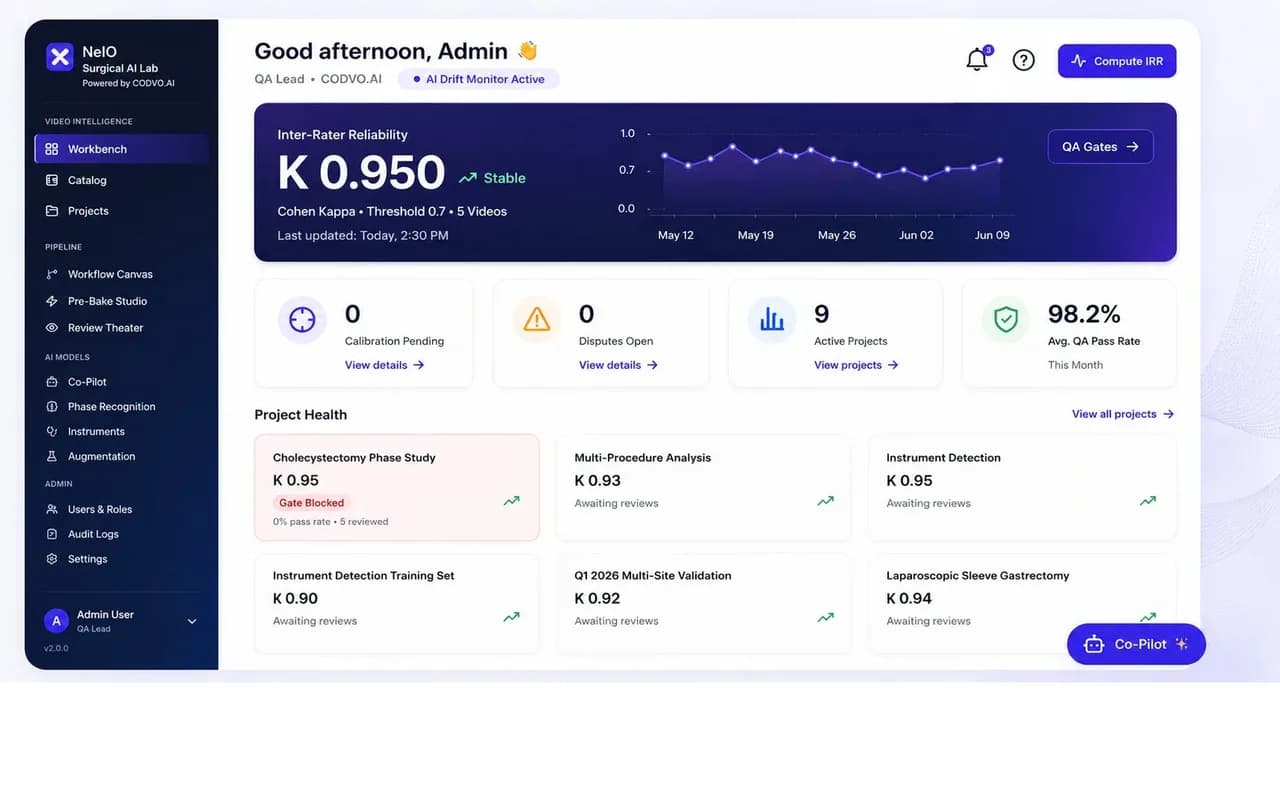
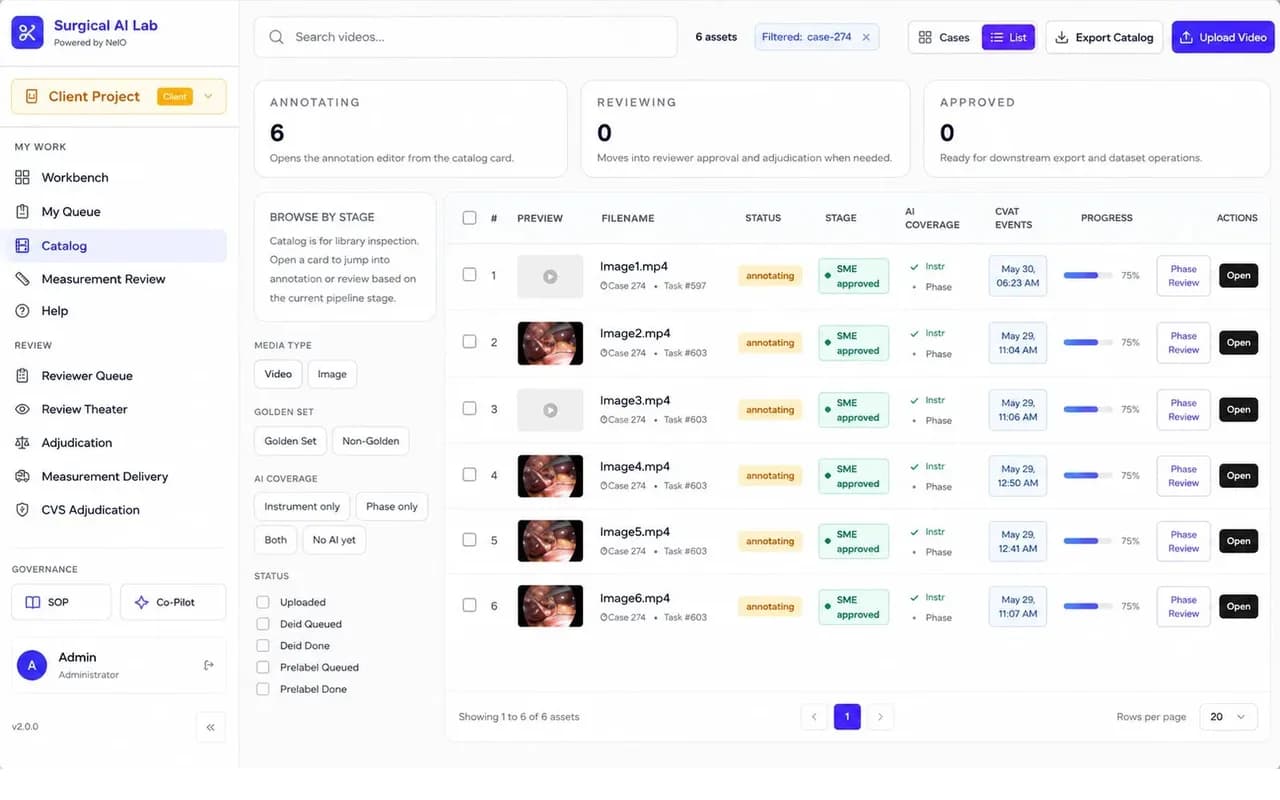
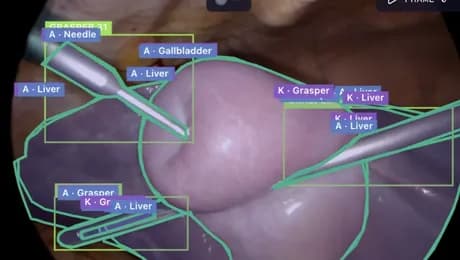
Choose a clip and a mode. Click any result to jump to the moment it came from.
Clip library
 ▶ 00:04:02
Laparoscopic cholecystectomy · Case 0142
00:01:08Camera inserted at the umbilical port; pneumoperitoneum confirmed.
00:02:40Trocar enters the field at the epigastric port.
00:03:15Liver retracted cephalad; gallbladder fundus partly visible.
00:04:02Phase boundary: Preparation → Calot dissection.
Case 0142 · Phase 1 · Preparation & port placement
Uncertain frames go to a clinician.
The agent sends each uncertain frame to a clinical expert with the frame attached. Your dataset receives only approved labels.
Works with the formats and systems you already use
The risk hides in the gap between what a label says and what the frame shows.
Measured against your thresholds
Every label is measured against thresholds you set before work began.
Clinicians on the hard cases
The agent sends the volume to trained annotators and only genuine ambiguity to a clinician, with the frame attached.
A trail behind every label
The agent records the source frame, confidence, ontology and SOP version, and every edit. Re-runs create new versions instead of overwriting.
Sovereign by design
Your surgical video never has to leave your environment to be labelled.
How it compares with a workbench and a labelling vendor.
It does the volume work, measures it against your own standard, and sends people only what needs a person.
| Capability | Annotation workbench | Labelling vendor | Video Annotator Agent |
|---|---|---|---|
| Procedure-specific clinical method | You bring it | Varies by vendor | Included and versioned |
| AI proposals on every frame | Some tools | Varies by vendor | Yes, with timestamp and confidence |
| Agreement measured against a certified annotator | Not built in | Often asserted | Measured per asset and batch |
| Ambiguity routed to a clinical expert | Manual | Labeller decides | Yes, with the frame attached |
| Lineage for every label | Partial | Delivery note | Source frame to released dataset |
| Runs inside your environment | Varies | Often off-site | Your cloud, on-premise or air-gapped |
Category-level comparison. Individual tools and vendors vary.
Label accuracy on an expert-graded reference set.
Inter-annotator agreement, measured between independent parties.
Graded against thresholds the customer set in advance.
One governed workflow, from procedure definition through to a dataset released with its evidence.
Define
Procedure ontology, SOP and ambiguity rules, locked before a frame is touched.
Annotate
AI-assisted, human-controlled temporal and spatial annotation.
Measure
Agreement against the golden set, label accuracy and model performance, scored per batch.
Adjudicate
Triggered when annotators disagree or a quality score falls below the gate.
Govern
Methodology, quality evidence and decision history released with the dataset.
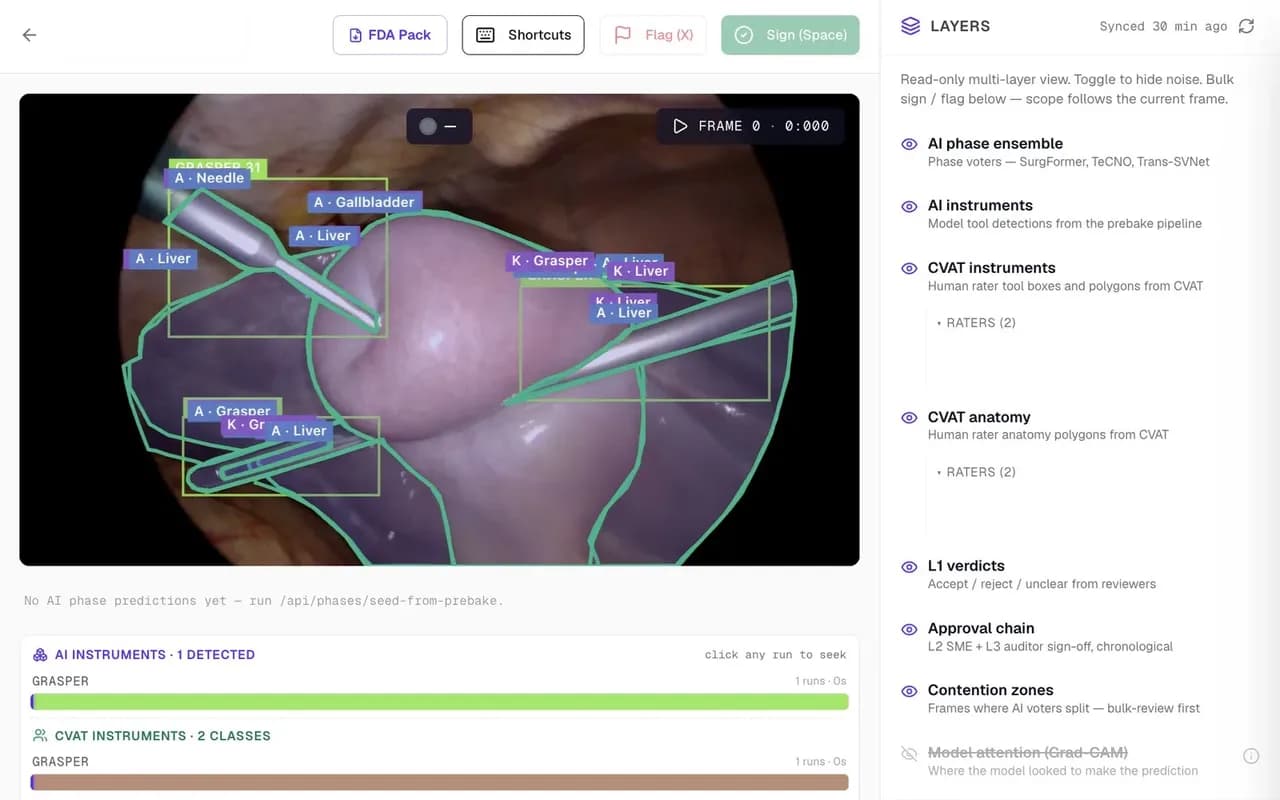
Instead of another labelling queue, teams get one governed view where proposals, disagreements and approvals meet.
See the frame and the disagreement.
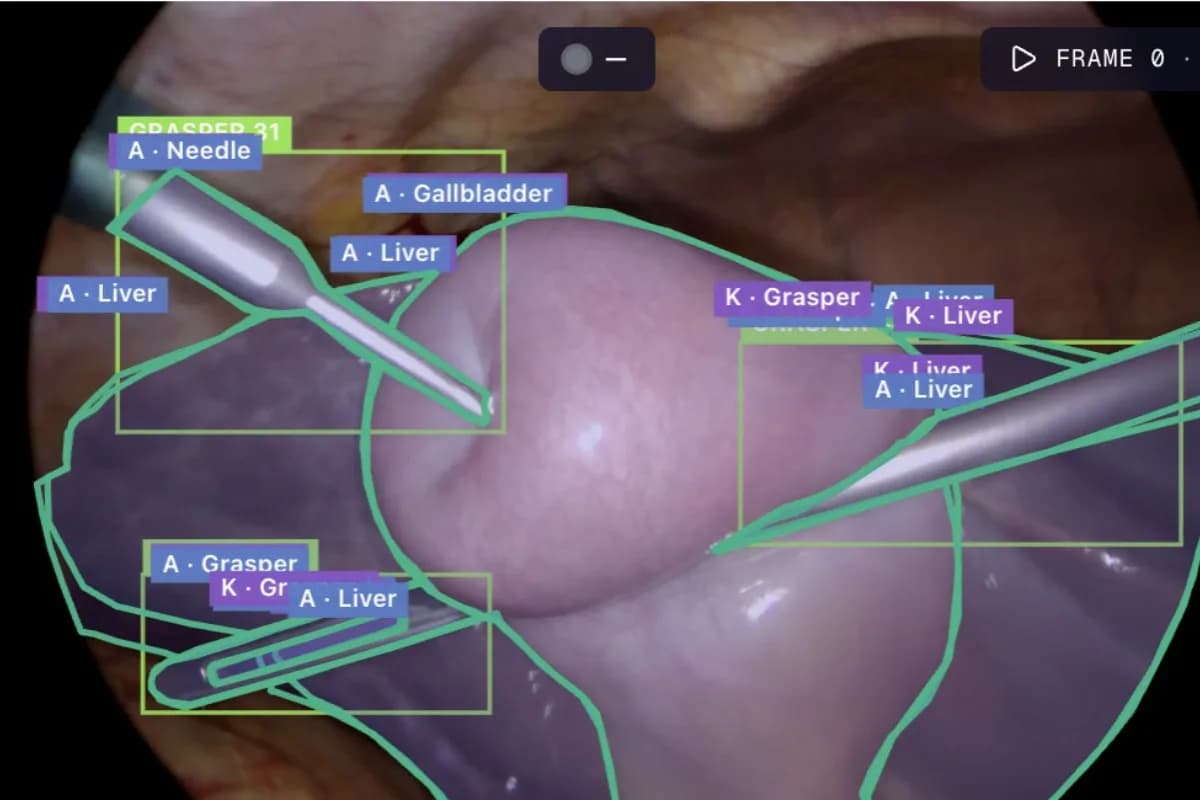 Illustrative
Two lanes feed one record.
Where one wrong label can be a stalled model, a failed audit or a submission delay.
Device & robotics
Hands your reviewer a training set with its methodology, review history and measured agreement attached.
Surgical AI teams
Holds every annotator and vendor to one versioned standard and measures agreement on every batch.
Hospitals & research
Runs inside your environment and sends your surgeons only the hard cases.
Annotation providers
Does the volume work and measures it against your client's own standard. Your people handle only what needs a person.
Regulatory & quality
Records who made each label, the instructions they followed and how each disagreement was settled.
Before
Procedure-aware ontology
Works to an ontology, SOP and visual rules written for the procedure and versioned before annotation starts.
AI pre-labelling
De-identifies each upload and pre-labels it with an instrument detector, phase ensemble Pro and anatomy segmenter.
During
Compare with an annotator
Measures each proposal against a certified annotator's label on the same frames, down to polygon boundaries with occlusion and uncertainty flagged.
Contention routing
Puts frames where AI voters split Pro first in review. Sign-off follows the approval chain: SME, then auditor.
After
Approve and release
Releases only approved labels to a versioned dataset your training pipeline can pull from.
Quality report
Computes accuracy, agreement, IoU and temporal delta per asset and batch, across six gates from calibration to clinical validation.
Always on
Per-label lineage
Saves every run, edit and adjudication as a new version, with who, when and why. One click shows where any label came from.
Continuous learning
Feeds validated corrections back to refine the method, target training and prioritise the next batch.
Pro editionEditions
Base is the governed annotation foundation. Pro adds the intelligence layer for continuous model improvement and complex programmes.
Everything required to define, annotate, review, measure and release surgical ground truth.
Best for: Proof Sprints, early production, controlled annotation programmes.The intelligence layer to continuously improve models, prioritise annotation effort and benchmark performance.
Best for: Recurring production, multiple models or procedures, active retraining.| Capability | Base | Pro |
|---|---|---|
| AI temporal phase pre-segmentation | Not included | ✓Included |
| Multi-model ensemble with contention flagging | Not included | ✓Included |
| Active-learning sample selection | Basic | ✓Advanced |
| Model registry with held-out evaluation | Basic | ✓Full |
| Adaptive per-annotator training hub | Not included | ✓Included |
| Analytics and benchmarking layer | Basic | ✓Advanced |
| Air-gapped deployment | Not included | ✓Add-on, where qualified |
| Support and service model | Standard | ✓Pro support, priority escalation |
Privacy & security. Runs on NeIO, in your cloud or VPC, on-premise, or air-gapped where qualified, under NeIO Govern controls.
Read moreHow is quality measured?
Label accuracy, inter-annotator agreement (Cohen's and Fleiss' κ), per-instance IoU, temporal boundary delta and presence agreement, computed per asset and per batch against the procedure's baseline, then reviewed by the QA lead before release.
Which procedures does it cover?
Laparoscopic cholecystectomy is in production use with a SAGES-aligned ontology and SOP. Endoscopy, robotics and other procedures are configurable on request using the same method structure.
Who annotates, and how are they qualified?
Annotators pass a domain check, reference-accuracy and agreement gates (κ ≥ 0.80) and supervised production before certification. Every annotator signs an NDA and confidentiality attestation before any data access.
What does it work with?
Approved labels release as a versioned dataset your pipeline can pull from. Nothing is copied into a new system of record.
Labels it handles: Phases · Instruments · Anatomy polygons · Events · Occlusion and uncertainty flags
Specific formats, destinations and versions for your environment are confirmed during scoping.
Why does annotation evidence matter now?
In January 2025 the FDA issued draft guidance that asks who annotated the data, what expertise they had, what instructions they followed and how disagreements were settled. In February 2026 the QMSR came into force. It brings in ISO 13485 by reference, which puts a purchased annotation service inside your quality system.
How do we get started?
Start from where your labels are today.
- Labels already exist. Compare them against a certified annotator and see where agreement holds and where it breaks.
- New footage, nothing labelled. Pre-label, review and release a versioned dataset. Clinicians see only the hard cases.
- One high-risk procedure. Run a Proof Sprint. You get a graded sample and its quality evidence, then decide whether to scale.
Bring one procedure and we will show you approved labels, each with its evidence, on your own footage.